
Water Flow
/THE MARMORATON MINE WATER FLOW STATISTICS
Luckily for all you statistic buffs out there, we recently received a water inflow and drainage report by engineer, Frederick Spannbauer, written in 1990, giving us some idea of the vast amounts of water to be dealt with on a daily basis.
Water Inflow and Accumulation
No record was kept of total volume of water pumped from the pit. A normal rate of pumping was measured with a V-type calibrating weir and multiplied with running time, indicating a probable volume of up to 20 Million Imp.gal. per month. This figure was used to calculate the cost of electrical energy required for mine drainage.
However, based on recorded in-situ excavation volumes, the amount of water accumulated in the pit since shut-down can be determined to an accuracy of a few million gallons.
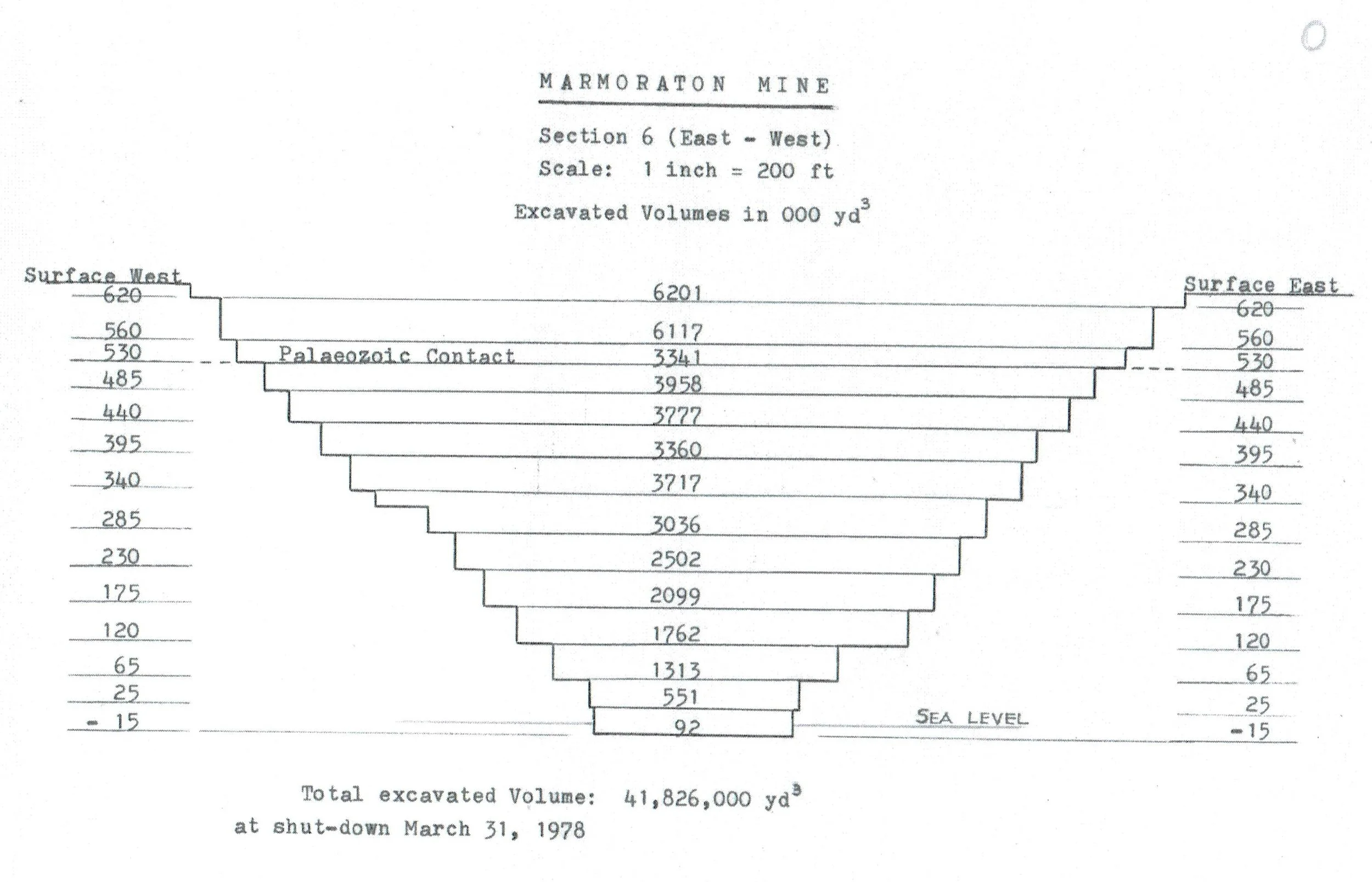
Marmoraton Mining Co. ceased operations on March 31, 1978, Mining was halted on the -15 level (15 ft below sea level), but pumping continued until May 1979, when the pumps were stopped for removal. In Feb. 1990 the water reached the 340 ft level (exactly), which means that all the excavated volume up to the 285 level is now filled with water. The mining record shows a total volume (from 285 to -15) of 11,626,000 cu,yd. or 1.955 Billion Imp.gal., collected over a period of 129 months, i.e. 15 Mill* gal/mo.,or close to 350 gal/mm.
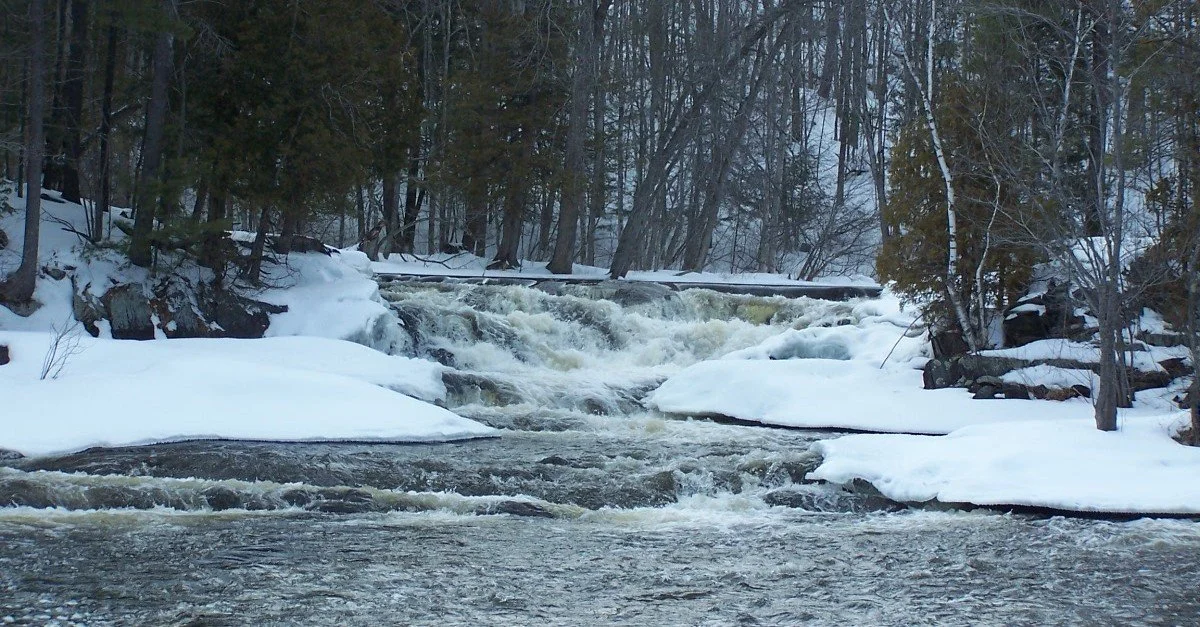
Though annual precipitation in Marmora has not yet been recorded long enough, 30-year averages are available from provincial records for Bancroft (880 mm), .Campbellford (811 mm), and Peterborough (774 mm) Assuming a mean annual total for Marmora of 822 mm (2.7 ft), falling over a pit area of 82 acres, results in 60 Million gal/year from direct precipitation, or 5 Mill gal/mo. Surface run-off into the pit is minimal; if blocked it would only add to the seepage. The rest of 10 Million gal/moo runs in trickles and small streams out of the rock-face all around the pit wall.
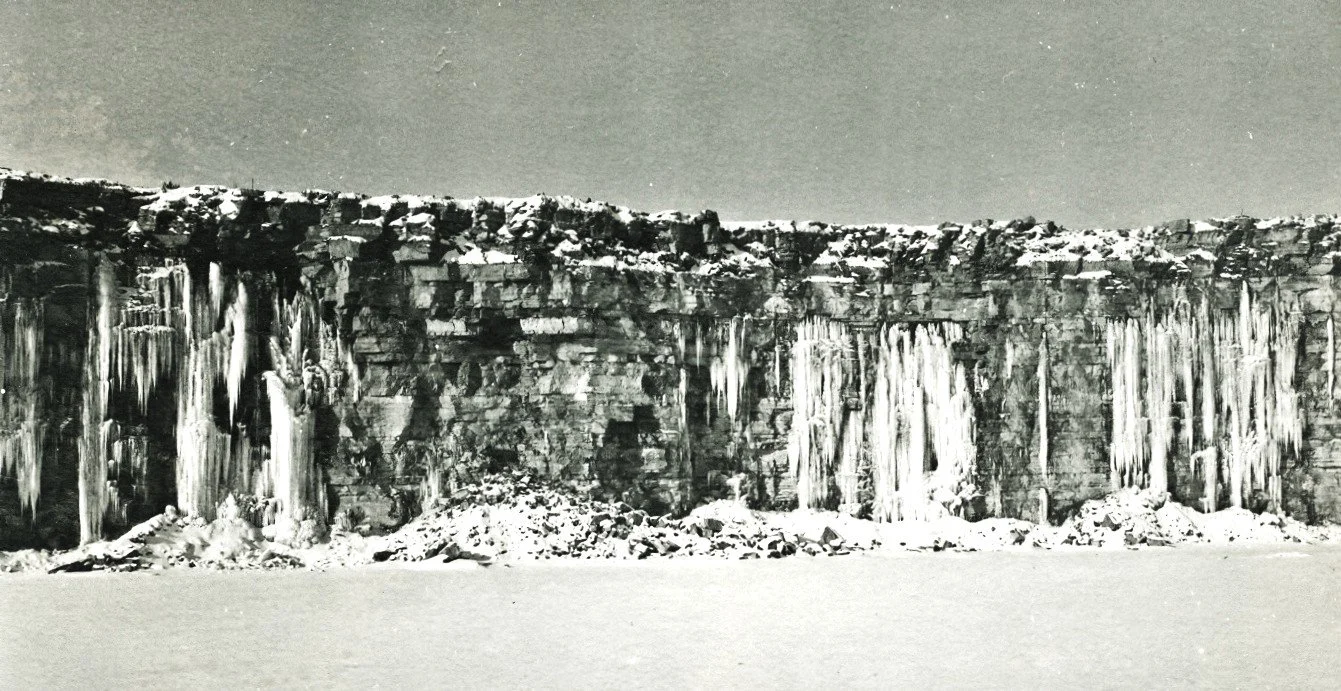
Most of the seepage originates in the upper 130 ft of Palaeozoic limestone, but well over 25% issues from a multitude of fissures and several faults in the Precambrian rock, from the 530 level to the bottom.
Copious amounts of water caused the southeast wall below the 440 level to become unstable. One night some 300 tons of rock gave way, completely blocking the haulage road at the 120 level. The roadway below this fault was later abandoned for safety reasons and re-routed north and westward, whereupon a whole line of 8 ft drill holes across a sinking cut on the west side at the 25 level gushed so profusely that stemming had to be poured right on top of each bag of slurry to keep it in the hole.
These are only two instances; many others were encountered and had to be dealt with. 53% of all blasting agent and slurry was designated for "wet" holes. To characterize the Precambrian formation as tight and impermeable would be quite misleading.
Mine Drainage Pumps
The primary pumps were two 250 HP Worthington, six-stage, vertical, bronze-impeller centrifugal pumps, each one rated 1000 Imp. gal/min at 600 ft head.
They were installed on top of a 22-ft high, 8-ft dia, sump (6000 gal.), constructed from two surplus rod mill shells, upright, end-to-end, on a concrete pad. This main sump was ultimately located on the 120 level east, below the former skipway.
Both pumps were connected to one 10-inch line, which, with about a dozen elbows, followed the contour of the pit wall over the top. The pumps were wired to operate in sequence with rising sump level, but normally one pump was quite adequate to take care of all drainage water, part of which was recirculated to keep the pump from cutting in and out.
When both pumps were put into service, however, they could move close to 2000 gal/mm (calculated when we filled a 100 ft tailings thickener tank with 300,000 gallons in less than 3 hours.).
The secondary pump was a 90 HP Gorman-Rupp submersible construction-type sump pump (two were purchased in 1970, one spare). It was lowered by crane into a depression or drainage sump on the lowest level, with a length of 6-inch flexible hose extending up to the next level and coupled to a 6-inch pipe feeding into the main sump*
Before acquisition of the submersibles we used two trailer-mounted Jaeger pumps, with 20-ft suction trunks, one driven by a 60 HP electric motor, the other by a 100 HP diesel engine. Both were kept in good repair and put to work occasionally. Secondary pumps were not required to raise water higher than two levels.
Mine drainage supplied most of the water for the beneficiation process (wet grinding and separation, conveying of concentrate and tailings etc.), The rest was drawn from a near-by, shallow, spring-fed lake of about 100 Mill, gallons, at an elevation of 580 ft above sea level, which is the approximate level of the local groundwater table.
Overflowing catch-basins or drainage sumps could usually be contained before they became an emergency, but three major floods in the 26-year mine life were of a magnitude to curtail operations. The cause of flooding was of course an unexpected surge of inflow, but complacency was a contributing factor.
The mine drainage system normally worked so well that it was accorded low priority. Even at the threat of a suddens pring thaw or heavy downpour no advance planning or system check was considered necessary. The alarm was sounded only when water began to accumulate. By the time all concerned personnel was alerted to put additional feeder pumps and lines into service, open dump valves, and generally streamline all components, precious hours were lost and we would be confronted with a couple million gallons of water, flooding three or four acres two feet deep. Once the system operated at maximum efficiency, it took only a few shifts, or at most a few days, to clear the pit of water.
The submersible feeder pumps were more versatile, self-priming, required shorter lines and could move more water when necessary. As the lower working levels became progressively narrower, more attention was paid to mine drainage and after 1970 no major flooding ensued.
It should be noted that the whole mining operation hinged on our ability to prevent the main pumps from being flooded, which was no big trick in a wide open pit, even before we placed them on top of a 22-ft sump. Confining pumps to the bottom of a 700-ft shaft or tunnel (e.g. for leachate collection) would drastically reduce the odds of keeping rising waters under control, and flooding would have to be anticipated at the first power failure.
March 1990 E. J. Spannbauer Submitted by Rita Spannbauer
COMMENTS:
Dennis Logan: I can always remember my Dad(Mike Logan) who worked for Armbro , talk about taking the Motor City motor crane to the bottom of the pit to move the pumps. It would be an all day job going to the bottom of the pit and back .
Mary Elizabeth Bonter: A lot of wells were dry until the pit started to fill
Josh Jones: What a cool read!
Andy J Johnson: Mr. Spannbauer was a genius,he was a neighbor & would always pick our brains with different problem solving quizzes etc. His boys were very smart as well. Such a nice family!
Terry Bell wrote on Mar23: Great article for the reminiscing by those so inclined. Having worked there in the 70s & worked with civil engineers at Alcan in Kitimat BC, found Fred's offering very interesting. Kudos to the Marmora Historical for sharing.
Dennis Logan : I can always remember my Dad(Mike Logan) who worked for Armbro , talk about taking the Motor City motor crane to the bottom of the pit to move the pumps. It would be an all day job going to the bottom of the pit and back .