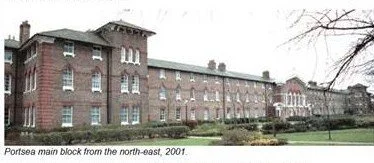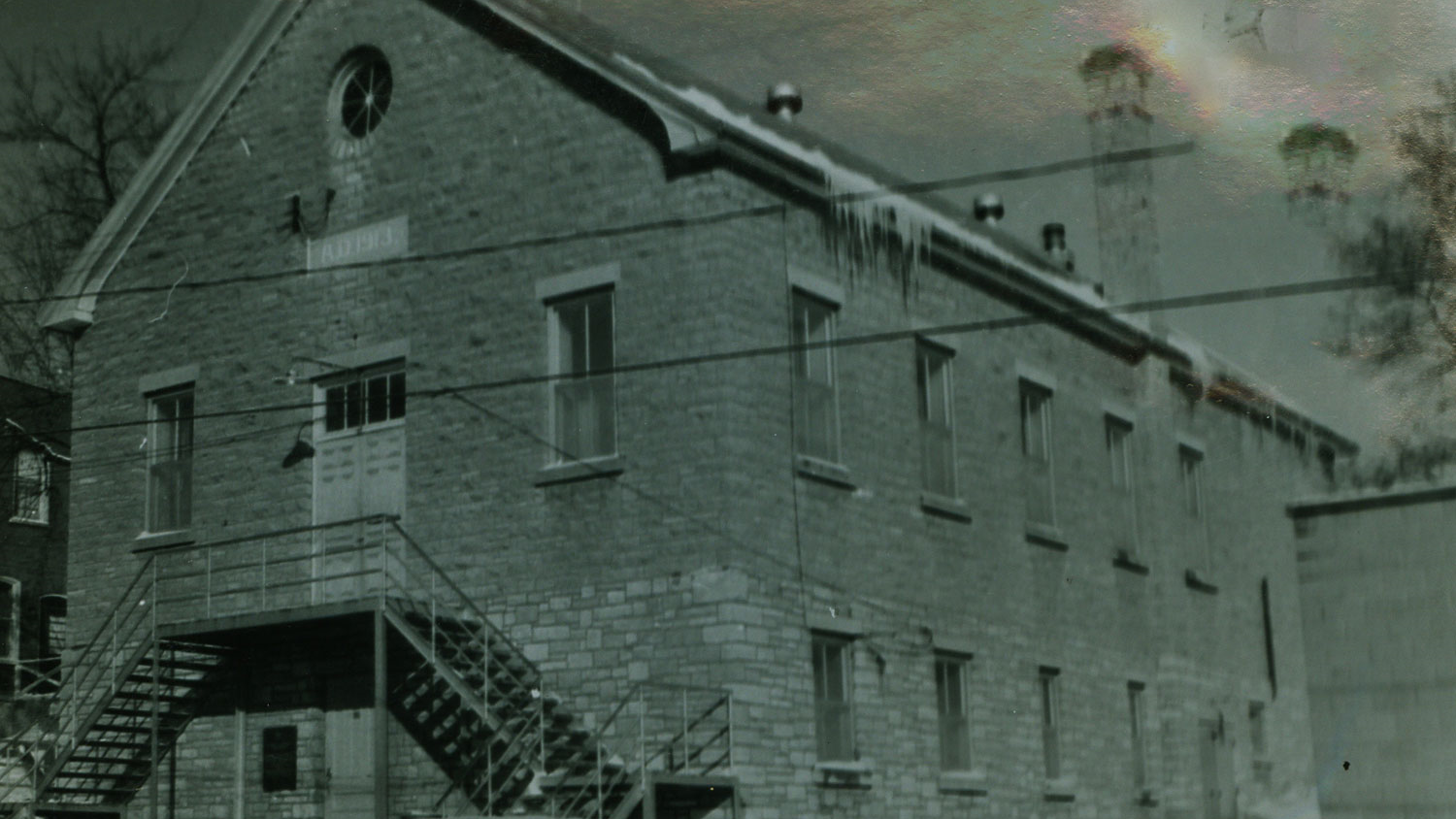
Deloro celebrated the opening of its new school in February of 1917. Teacher: Miss Oswald "A Fairy Play will furnish the entertainment and it should draw a packed house." Marmora Herald
HISTORY OF THE DELORO PUBLIC SCHOOL
by Mr. H.R. Haacke, School Board Trustee 1924-1948 Donated by Mark Haacke Transcribed from handwritten notes circa 1963
The life and health of the Deloro Public School, for fifty‑four years, was intimately tied up with the successful management of the various companies owning the village. This in turn was largely dependent upon three prime factors: the executive directorship, the development of new smelting and refining processes, and the strength and extent of world markets for cobalt and for silver.
During mining camp days there is no mention of schooling. When the first meeting was called to plan the organization of a school in July 1909, the informal village situated on Company property consisted of the plant, five large houses serving as offices and the homes of officials, and six double houses for skilled workmen, plus a boarding house for about fifty labourers. A village hall had been built by volunteer labour; it housed a complete library. Many outlying parts of the Company land were built up in a rather haphazard fashion but served to house workmen and their families despite their inconvenience of location and inadequacies of construction. No man could own a home there.
A small general store just outside the company domain was operated by a local farm family, and the post office was a quarter of a mile down the road in a pioneer farmhouse. These were both incorporated into a store built in the village about 1919, and this was named the Deloro Trading Company Limited, which was 51% company owned. This step effectively excluded local folk from participating in the company's business except for the sale of fresh foodstuffs and fuel. Around the same time, the T shaped village street was extended to hold some 28 more residences of varying degrees of comfort and efficiency.
The school, organized in 1909, serves the School's Section 11, Marmara Township, a general area centered around the village. There were three trustees selected at the general meeting. Often, only two of these were present at the trustees' meeting. The school was held in the basement of the village hall.
The general register begins on October 14, 1909, and the teacher was paid $450 per annum, based on a school year of 213 days. The number of pupils increased rapidly, and the teacher requested a salary of $500 for 1910. This was agreed to by the trustees. Money was a scarce commodity, so an entertainment was held in the hall in early October 1910, which was successful in every way, netting $30 to help ease school finances. When the teacher left at the end of the year, advertisements in the Toronto “Globe” produced one teacher who stayed from January to June, another for September and October, after which the trustees regret no school being held in November and December, as there was no teacher. City papers bringing such a doubtful harvest, the ensuing period saw a young lady from Marmara with a permit hired. When she was ill, a relative took over, whether with or without a permit, is not recorded.

1914 School in the deloro Hall
After the resignation of four auditors in a row, an elderly local farmer was appointed. His name and that of his son appear frequently as trustees, auditors, and for chairman of the general meeting. By July 1914, a schoolhouse was seriously needed. The most suitable site was owned by said farmer, who refused to sell. He and other outside residents looked to the company for a donation as most of the scholars were children of their employees.
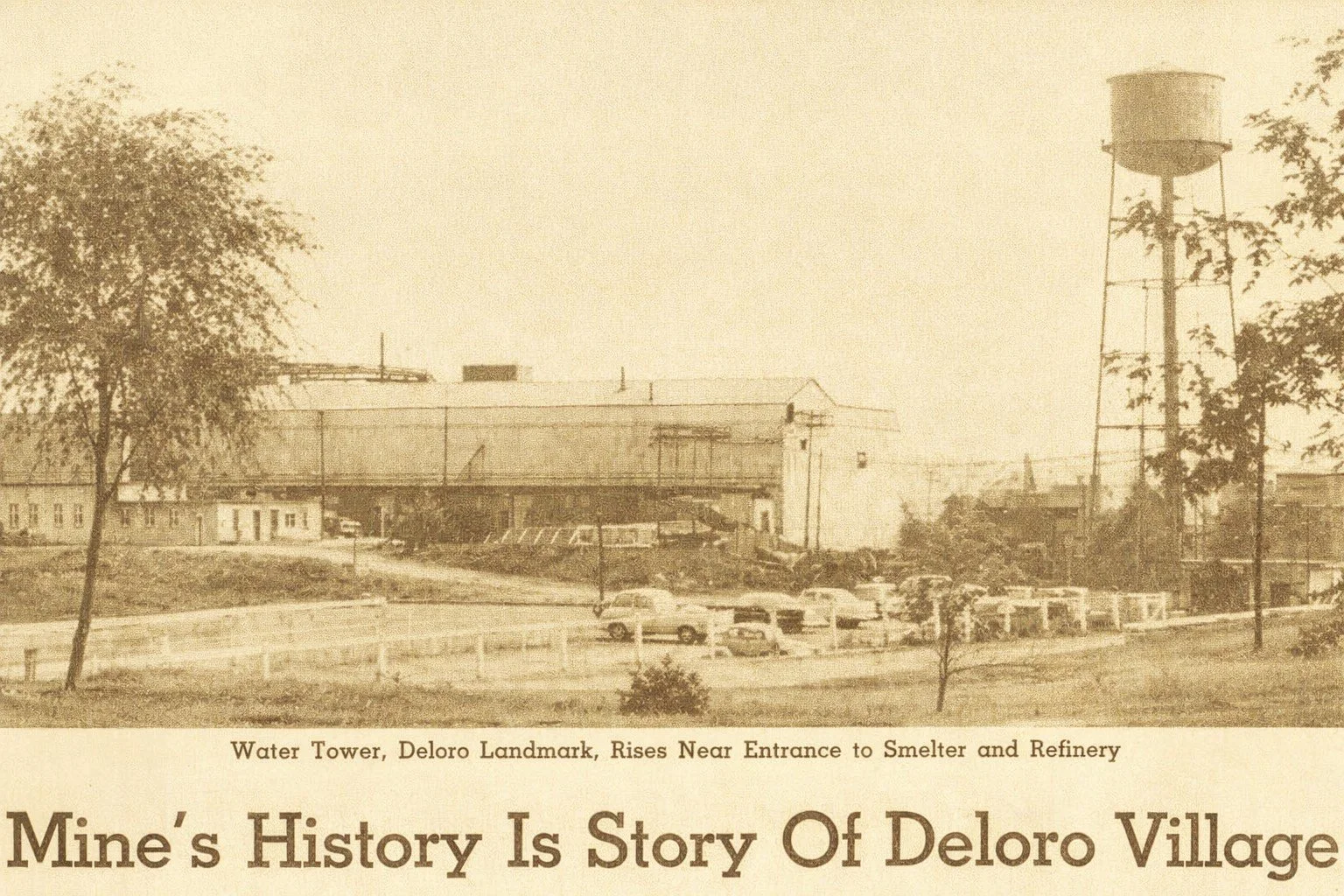
Company men, in their turn, laid stress upon its past kindness in allowing the use of the basement of the hall. It was perhaps providential that the opening months of World War I gave everybody something else to think about while it promised prosperity for the plant and more security for the resident villagers. When the Deloro Smelting and Refining Company was evolved from the old Mining and Reduction Company in 1915, a site within the village boundary was provided by the company, and a school building was begun.
1917
The day is not specified in mid-January, 1917, when the school was finally occupied. The one-room building was designed to include an addition at some future date, and the ample basement served the company well, if unexpectedly, when the wooden boarding house burned down about a year after the completion of the school. During the Christmas vacation, many of the homeless workers were billeted in the school basement, although this was only indicated in the minutes when it raised a nice question of fumigation and sanitation between the trustees and the company. It did lead, I may add, to a complete overhaul and improvement of the sanitary arrangements in the school.
circa 1917

Deloro, 1918 - 1919- 2nd row, 4th girl from right is Blanch Nicholson, aunt of Marilyn Wood Wren
From January of 1919, when the village of Deloro was created, it is interesting to note that the system of electing the trustees for the Deloro Public School Board followed the system used in electing the Reeve and Council. The required number of applicants was carefully nominated and duly declared elected. Only once, in 1925, was an extra person, a lady, incautiously nominated for trustee. She was immediately considered to lack the necessary qualifications as a taxpayer and was deemed to have resigned, although hers was historically the second female nomination, and no question whatever had been raised concerning the former incumbent whose nomination fitted into the pattern. It was not until 1948 that some daring villager nominated an ordinary workman for membership on the village council, causing the first election in the history of Deloro Village. It was certainly a trend of the times and may have been a portent of the end that the voters elected the unconventional nominee at that time.
Early Teachers at Deloro Public School
1909 M.B. Alexander 1910 M.B. Alexander 1911 M.B. Alexander, F.J. Nickle and E. Mackie 1912 D.M. Jones 1913 D.M. Jones first half; A.V. Yates second half 1914 A.V. Yates 1915 A.V. Yates first half, J. Lukes second half 1916-17 Miss E. Oswald 1917-18 E. Oswald 1918-19 |E. Oswald 1919 V Criag (second half)
With the incorporation of the village, children from the surrounding area were no longer eligible to attend school at Deloro. Although a fee system was tried in certain cases, it proved unworkable in practice and was shortly abandoned. School taxes paid by the company, which was the sole taxpayer, were assigned 80% to the Roman Catholic system, benefiting mainly the town four miles away and 20% to Deloro Public School. The assessment eventually totalled $450,000 so that the withdrawal of the company in 1960 and the pursuant sale of and demolition of most of their property caused a seriously critical situation for the school board.
By the end of June 1919, the teacher's salary had reached a great sum of $800 per annum. Securing the services of the next teacher at $700, the Board voted that the legislative grant of $100 be used to augment her salary. One year later, advertisements offered first $800, then $900, and later on a $1,000 figure was approved for a male applicant, one who never did come. In December, the trustees were still arranging to interview applicants. Discussions concerning methods of discipline in May led to that teacher's resignation, and a closing date of June 24 was arranged for the school. At $1,000 this time, approval was belatedly given in November for the secretary's action in engaging a returned serviceman at $1,100. The following year, he was re-engaged at $1,250. Although male teachers were sought thereafter, the following engagement was with it a quiet little lady at $1200.
tHE CLASS OF 1921 not in any order Eric Mantle Grace Skellet Doris Jackson (absent) Harold Boycott Eva Clarke Martha Chesney Annie Mckinroy Daisy Smith Cora Robertson Ivy Skinner — moved Amelia Clarke Norman Smith Thomas Hobson Lena Cross Betty Wright Violet Hobson Grace Holcombe John Gibbs Lily Boycott Clifford Robertson Willie Skinner - moved Marguerite Jackson Gwendolyn Gibbs George Mantle Ralph Holdcombe William Smith George Empey Evelyn Rice Eileen Mantle Fred Holdcombe Andrew Chesney (absent) James Rice Rosy Mantle George O’Neil Violet Reneuf Merle McCormack Millie O’Brien (absent) Jack Phillips (absent) John O’Neil Thelma Green May Hobson Dorothy Boycott Marguerite Robertson Jimmie Cross Cyril Boycott (absent) Craig McCormack Philip Reneuf (absent) Simmie Smith Teacher: Miss Hannah
By this time, the press of pupils again created the necessity for a building program entailing the remodeling of the basement of a junior room in 1925. A welcome gift of $1,000 from the company, caused rejoicing among the public school taxpayers. From that time on, a principal and assistant received salaries that ranged from $1,200 and $1,000 for Class II certificates upwards. In 1948, the principal received $1,700, the same rate as was basic for incoming teachers in Toronto and North York at that time. From 1927 to 1938, one lady principal was retained and her assistant remained from 1929 to 1937. There were frequent marks of appreciation from the board during this settled period, and Deloro was the one school in the whole district where salaries were not reduced during the Depression, although the government grant was 43% compared to a former 50% of the teachers' salaries. By 1954, the salaries had reached $2,900 and $2,200 respectively.
Some highlights of the medical supervision of the school are interesting. On April 16th, 1920, the company doctor inoculated all the children against smallpox. From April 19th to the 23rd, the school was closed due to smallpox. During the years of residency of a company nurse, health inspections were carried out annually. The dentist from Marmara volunteered his services for dental inspection, and the company provided him with an office for one half day a week, in which he supplied excellent dental service for the whole village.
In 1931, due to epidemics of sore throats, scarlet fever, diphtheria, typhoid and bovine tuberculosis, the company doctor sent out an advice to parents on the method of pasteurizing milk at home. Incidentally, very few families had any facilities for cooling the milk quickly after the heating process. Anticipating the forthcoming complaints, the doctor tacked on a suggestion for adding a little cocoa, chocolate or some other flavoring to the finished product should the children object to the change in taste.
Arrangements for an additional room to be built on the school in 1937-38 developed the first real sign of independence among the public school supporters. The company could see no reason why they should make a grant towards an addition. If the public school wanted a new room, they would have to take care of the cost by an increase in their rents. Concerning these, there were perhaps a dozen houses of such quality as to entail a 50 cents a month increase, while the others were expected to bear a rise of 25 cents each. These amounts had to be doubled once the matter had been taken up with the head office in Ottawa, but a personal canvas by the trustees showed the public school supporters 100% in favor of proceeding.
The inspector confirmed a $600 grant from the Department of Education. Costs were whittled to the bone and the extra room became a reality. The basement was readily converted into a manual training and home economics centre and the experience of the teachers who then took charge for about 10 years is again typical of the strongest and the weakest features of the company village organization. No pains were spared to assist and accommodate these fine teachers in any way that was open to the board. Equipment was procured for the crafts room and I expect company carpenters were largely if not entirely responsible for the workbenches, tool racks and cupboards installed. Rhythm band appurtenances were obtained, an itinerant music teacher visited the school and the pupils took part in various festivals. A planetarium had already been installed and films are mentioned fairly frequently.
Drafting and industrial arts and crafts classes were open for older boys in the evening, and the village held the teachers in high esteem. Being engaged to marry, however, the teachers were informed that no company house had ever been available for that purpose, and ergo they must forget about marriage or else! It took a minor earthquake to overcome the rooted custom and prejudice involved in this decree, but at last a little house was made available for the teacher to rent. From that time on, a house to rent was considered quite a reasonable adjunct to the principal teaching position, and there are records of choosing colours for the walls as well as directions for the company painters concerning the size of floor borders needed around the incoming rug.


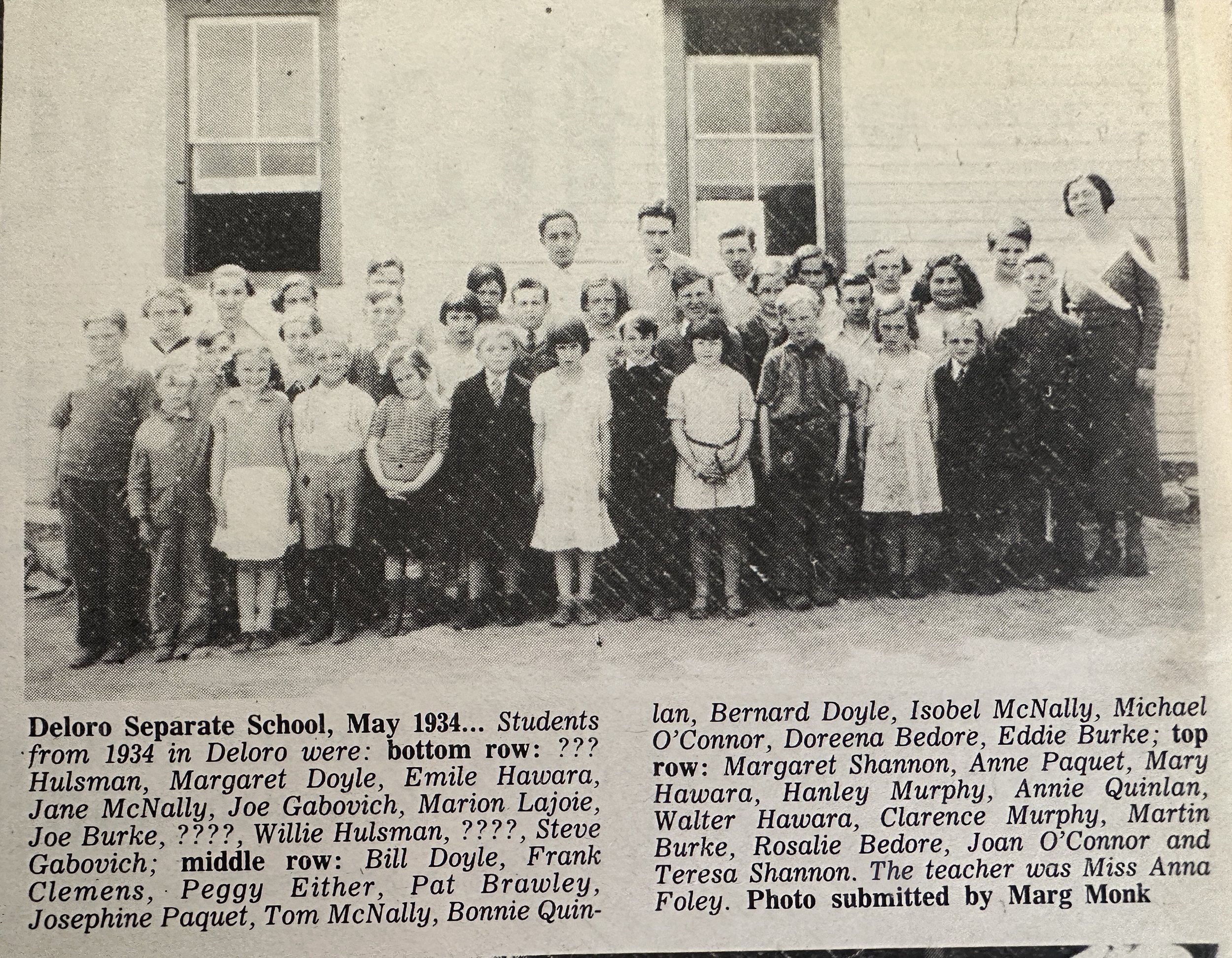


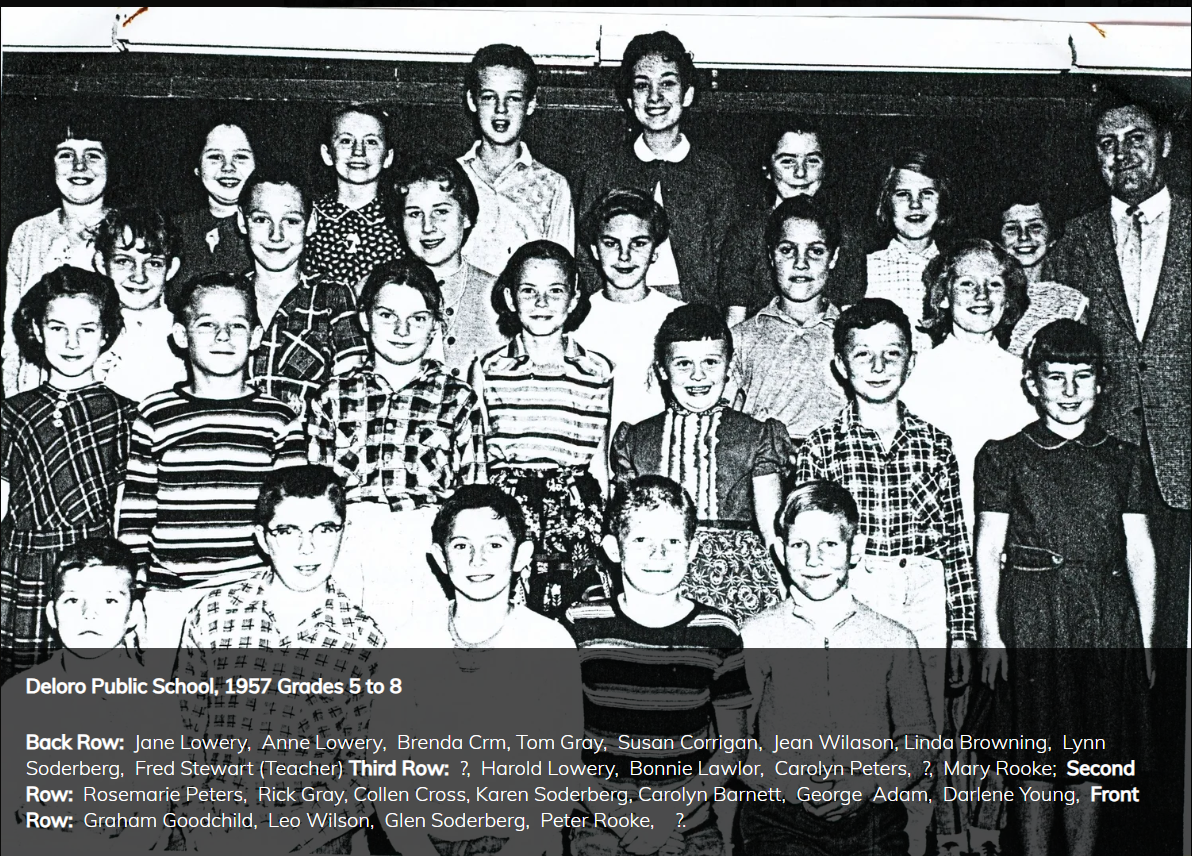
Some items of unusual occurrences lighten the board minutes, school registers and daily procedures. Teachers had to be admonished concerning types of punishment and in one case, putting a child under the desk for a time was to be discontinued. In several different regimes, teachers were reminded that they were not to change the dates of school holidays or take off for fall fairs without first consulting the board. The board had to insist that exam results be made known to pupils before the summer holidays. It was considered an unhappy situation when school was being dismissed early so the principal could work at the plant after. On more than one occasion, opening hour and lunch recess had to be insisted upon as a standard, regardless of events of the previous evenings or the whims of the then teacher. On the other hand, one teacher who left for service in World War I eventually became general manager of the company.
Drilling to deepen the well in 1953 was charged at a rate of $5.50 per foot through limestone rock and $9 for each foot of volcanic rock. At one time, water for all purposes except drinking was provided by a connection to one of the old flooded gold mining shafts. One December meeting heard a report that of the two men approached about cutting the long grass behind the school, one didn't feel up to it and the other didn't get around to looking it over until the season was too far advanced for any action to be taken.
Pencilled notations on the teacher's application, such as “Looks like we drew a lemon”, where age and certificate varied significantly from the statement made. “ Presumed the $2000 salary rules out this gent”, as it did, and “Inclined to be a little dictatorial”, give some hint as to the difficulties faced by the board in selecting new teachers. One male applicant gave all his vital statistics in finest detail, but alas, to no effect.
Book lists include one for the period 1-6-26 to 11-11-26, wherein eight books of the vintage “The Prisoners of Chillon”, “Gray’s Elegy” and “John Gilpin” were purchased at a cost of $4.26. There is also a list entitled “Have Not”, where disapproved books are itemized. Among inclusions still to be found in the registers are a prize list for the Marmora Fair, a recipe for a cheese-mustard sauce of some sort, teachers' convention programs from the ‘30s in which Deloro teachers took an active part. One mentions a banquet dinner to cost 35 cents per person.
A notation in a children's hand in the General Register shows that one pupil had moved to nowhere. Another such purports to show that the middle child of the General Manager had moved to the nearest country school, although her two sisters did not. The son of another General Manager shows no record whatever of doing Grade 8 work, and no record of attendance for that year, although he went on to high school without having been absent from the village. At that, he wasn’t as clever as the little fellow who was reputedly born on the date 7.7.51 and was entered on the daily register from 4.9.51.
With the closing of the plant entirely in 1960 and the Company’s withdrawal from the Village except as a taxpayer, the assessment dropped to $145,000, and will be down to about $60,000.00 by the end of this year. The 72 year “dollar-a-year” lease settled in 1941 was terminated and the school site was made over to the Board of Trustees. With this concession, the school board was able to rebuild their system and withstand the buffeting winds of change. Disintegration and recreation of the Village organization were going on almost simultaneously. Homes became available for purchase for the first time since 1868 and some forty-five households in all now exist. The Village was re-incorporated and elections are held each year. Eighty-seven voters turned out on election day last year, the absent few being summer or weekend residents only.
The drop in assessment and removal of many citizens posed serious problems indeed for the trustees. The coincident amalgamation of the Roman Catholic Schools into a central area aggravated Deloro’s problem and created a similar situation in the rural schools around the Village. There would be only 17 children in the Deloro school this year, perhaps half that many in each outlying school, and Deloro especially would have found it impossible to carry on under these circumstances. Instead of collapsing under its impossible burden, however, Deloro Trustees took stock of their two fine classrooms and the crafts room downstairs, and rose to the occasion by selling education to the whole district. They have ensured the school’s being open to the Village children, while sharing the benefits of adequate teaching and good equipment with the country pupils; they have reinforced their financial position into the bargain.
COMMENTS
Lew Barker writes: Hilda Henderson taught there for many years.
Brenda Brooks: All the Brooks children attended this school including many aunts and uncles on the Smith side. The teachers were Mr. and Mrs. Hooey, Florence Henderson and Fred Stewart, all of them very memorable. For a school of that era which provided shop and home ed classes for all provided with a good start, together with the sports activities.
James Dalton adds: The teachers-Mrs. and Mrs Hooey--Miss Henderson-wonderful years-lots of stories here
It may seem that the school at Deloro has come full cycle, except that country children are no longer expected to walk to the school, but this would overlook the advances made. Besides the checkered history of struggle and success now attached to the school, adversity has fostered the growth of a sturdy background and paved the way for gradual freedom from domination and effective independence by concerted action. The pleasant classrooms themselves, the enlarged school grounds and plant all vouch for the success of the enterprise. So do the 629 pupils whose names appear on the rolls between 1909 and 1959. There were 26 teachers in that time, of whom ten held forth in the Junior Room, leaving 16 as the total turnover of teachers‑in‑charge during fifty years. The school’s Diamond Anniversary in six years’ time will be a triumph of stable accomplishment accredited to those who built so well. There were times when such cooperative undertaking in such a small centre were bound to sound discouraging to eager minds, and a tendency to down-grade the worth of their contributions was included to develop; but Canada is founded after all on results dependent upon the sums of such efforts. Indeed there is no method of calculating the full effects of any solid, persistent, honest effort of this sort. It spreads in complex ripples that never cease, and affects others unendingly.
Emerson spoke truly when he said “Nor knowest thou what argument thy life to thy neighbour’s creed hath lent.”
unknown
May 19, 1939. Deloro, Ontario. Miss Sylvia O’Brien, Mr. Clarence Hooey - Teachers
Left to right - Top Row — (from left to right:) Miss O’Brien, Vera Hegadoren, Violet Wiley, Jean Elliott, Dorothy Yates, Vera Eggett, Margery Smith, Anna Koski, Doris Hegadoren, Winnifred Brooks, Muriel Simmons, Betty Smith, Isabelle Leal, Gladys Matthews, Eldora Vincent, Stella Cross, Beatrice O’Neill, Barbara Crainford, Gladys Cross, Wellington McInroy, Mr. Clarence Hooey. Second Row — John Mumby, Raymond Goodchild, Eric McInroy, Earl Cousins, Bill Mumby, Charles Loveless, George Cheeseman, Shirley Quinn, Donalda Wiggins, Jacqueline Leal, Joyce McInroy, Mary Smith, Mary Kurika, Virginia Robertson, Ruth Koski, Nancy Eggett, Arlene Hegadoren, Russell Hegadoren Third Row — Stella Kurika, Joyce Bradley, Dianna Quinn, Margaret Wiley, Thelma Wiggins, Joan Brown. Sitting — Tom Yates, Stan Brooks, Wilbert Wiggins, Gordon Eggett, Frank Leal, Raymond Wiley, Wayne Brown, John Barlow, Sidney Brooks, Herbert Wiley, William Koski.
Written by John Barlow
1953
Deloro Public School 1943, Home Economics class.
Teacher, Mrs., who married Mr. Hooey., another teacher at the school Front left, Margaret, Wiley, Dorothy Wiley, Margaret Drew, , Jean Watson, _____, Back row, June Loveless, Anne Barlow, , Evelyn Brooks, Betty Cox, Sheilagh Corrigan.
The quilt was the result of a competition to see how many squares each student could make. This turned into a lively competition as each student tried to see if they could win the number of squares completed.